¶ Introduction and Context
armasuisse is the federal government's centre of competence for procurement, technology and real estate within the DDPS (Federal Department of Defence, Civil Protection and Sport). With approximately 1,020 employees and an annual procurement volume of around CHF 2.5 billion, armasuisse manages over 15,000 contracts per year. [1]
Today's organisation was created as a consequence of the Mirage Affair of 1964: massive cost overruns led to the first parliamentary investigation commission (PUK) in Swiss history and the resignation of Federal Councillor Paul Chaudet. [2] The former War Technology Department was gradually restructured to become today's armasuisse -- with the goal of institutionally separating procurement from military use.
Six decades later, the SFAO (Swiss Federal Audit Office), the Parliamentary Oversight Committees (GPK) and the Finance Delegation continue to identify recurring central patterns in numerous reports. This page documents the publicly available findings -- from the Mirage Affair of 1964 to the F-35 cost overruns of 2025.
Note: This page draws exclusively on publicly accessible reports from the SFAO, the GPK, the Finance Delegation, the Federal Supreme Court, and reporting by reputable quality media. Where armasuisse or the DDPS have issued statements in response to these findings, those counter-positions are also presented.
¶ Balance Sheet: 60 Years of Procurement Losses
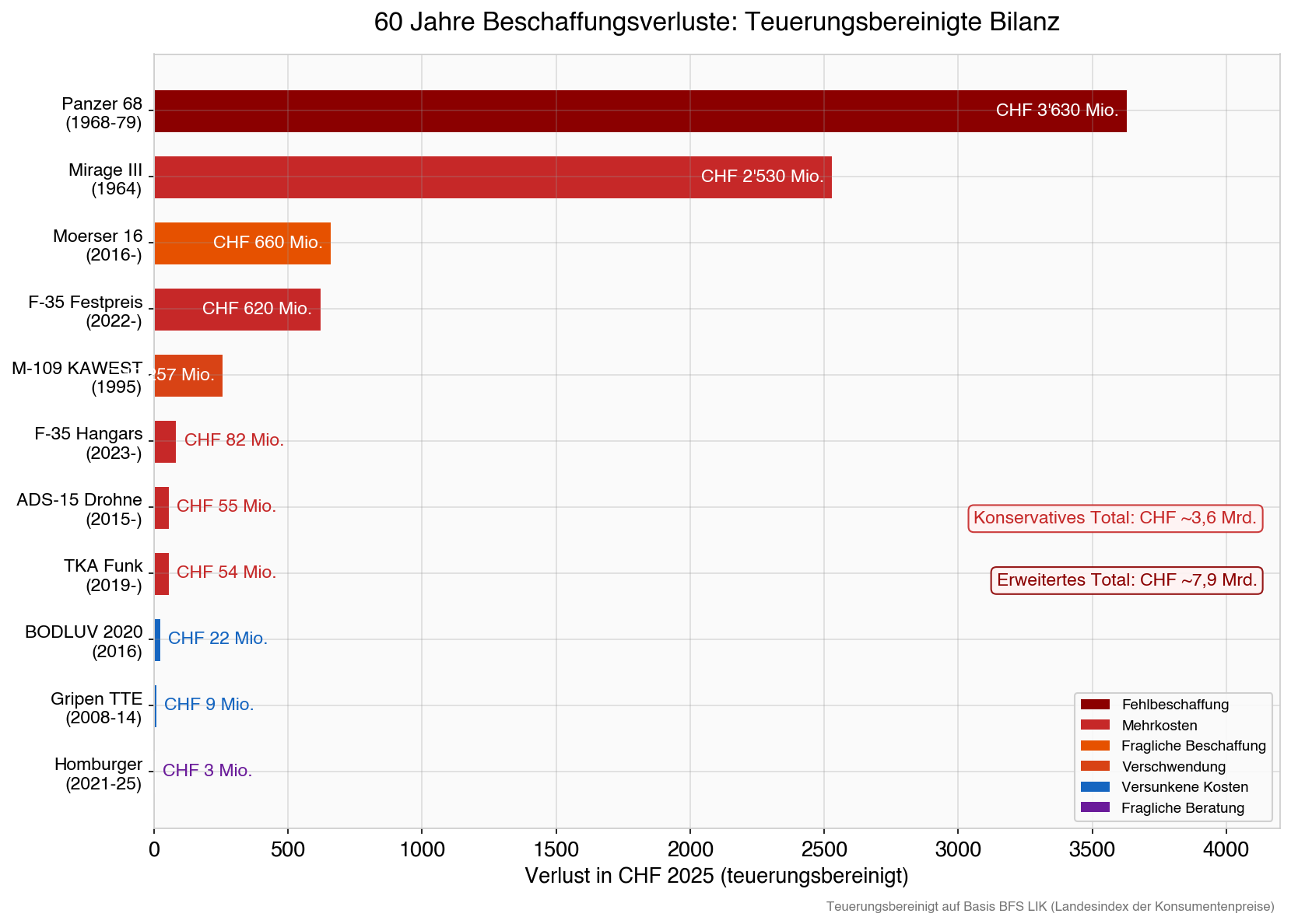
The following table summarises the documented financial losses from failed, problematic and overpriced defence procurements. Inflation adjustment is based on the Swiss Consumer Price Index (CPI) of the Federal Statistical Office. [65]
| Project | Period | Loss (nominal) | Factor | Loss (CHF 2025) |
|---|---|---|---|---|
| Mirage III: Cost overrun | 1964 | CHF 576 million | ×4.4 | ~CHF 2,530 million |
| Panzer 68: Militarily inadequate system | 1968--79 | CHF 1,100 million | ×3.3 | ~CHF 3,630 million ¹ |
| M-109 KAWEST: 124 unnecessary modernisations | 1995 | ~CHF 214 million | ×1.2 | ~CHF 257 million ² |
| BODLUV 2020: Project cancellation | 2016 | ~CHF 20 million | ×1.1 | ~CHF 22 million |
| Gripen TTE: Failed procurement | 2008--14 | CHF 8 million | ×1.1 | ~CHF 9 million |
| ADS-15 Drone: Cost overrun | 2015-- | CHF 50 million | ×1.1 | ~CHF 55 million |
| Mörser 16: Disputed award, 7-year delay | 2016-- | CHF 600 million | ×1.1 | ~CHF 660 million ³ |
| TKA Radio Devices: Cost overrun | 2019-- | CHF 50 million | ×1.08 | ~CHF 54 million |
| F-35 Fixed Price: Additional costs (conservative) | 2022-- | ~CHF 590 million | ×1.05 | ~CHF 620 million ⁴ |
| F-35 Hangars: Cost overrun | 2023-- | CHF 80 million | ×1.02 | ~CHF 82 million |
| RUAG Fraud: 26 suspected cases | 2014--23 | Not quantified | -- | Not quantified |
| Homburger Legal Opinion: Disputed consultancy | 2021--25 | CHF 2.5 million | ×1.05 | ~CHF 2.6 million |
| Conservative Total (additional costs + sunk costs) | ~CHF 3,631 million | |||
| Extended Total (incl. Panzer 68 + Mörser 16) | ~CHF 7,921 million |
Explanatory notes:
- ¹ Panzer 68: Total costs of CHF 1,100 million for 390 tanks according to the NZZ [53]. The system had serious technical deficiencies (self-firing cannon, defective protection systems) and failed to meet military requirements according to the parliamentary investigation report. It nonetheless remained in service until approximately 2005 and was scrapped for lack of buyers. Inflation factor ×3.3 (FSO CPI, procurement period 1968--1979, midpoint ~1973). Classifying the total costs as a "loss" is justifiable but not uncontested -- the system was used for decades despite its deficiencies. It is therefore only included in the extended total.
- ² M-109: Of 348 modernised self-propelled howitzers, army planning required only 224 -- 124 vehicles (36% × CHF 600 million) were modernised unnecessarily. [64]
- ³ Mörser 16: The SFAO criticised the absence of "genuine competition". [62] According to experts, the open turret system is highly vulnerable to drones. [63] The CHF 600 million represents total costs, not additional costs -- the system is being delivered, but its utility is disputed.
- ⁴ F-35 Fixed Price: Conservative estimate based on the lower end of the cost range (USD 650 million to 1.3 billion [8]), converted at the average 2022 exchange rate (~0.91 CHF/USD). The actual additional costs may be substantially higher.
Conservatively calculated, the documented procurement losses amount to approximately CHF 3.6 billion in today's prices. If the total costs of disputed systems (Panzer 68, Mörser 16) are also included, the figure rises to approximately CHF 7.9 billion.
¶ Historical Procurement Failures
¶ Mirage Affair (1964)
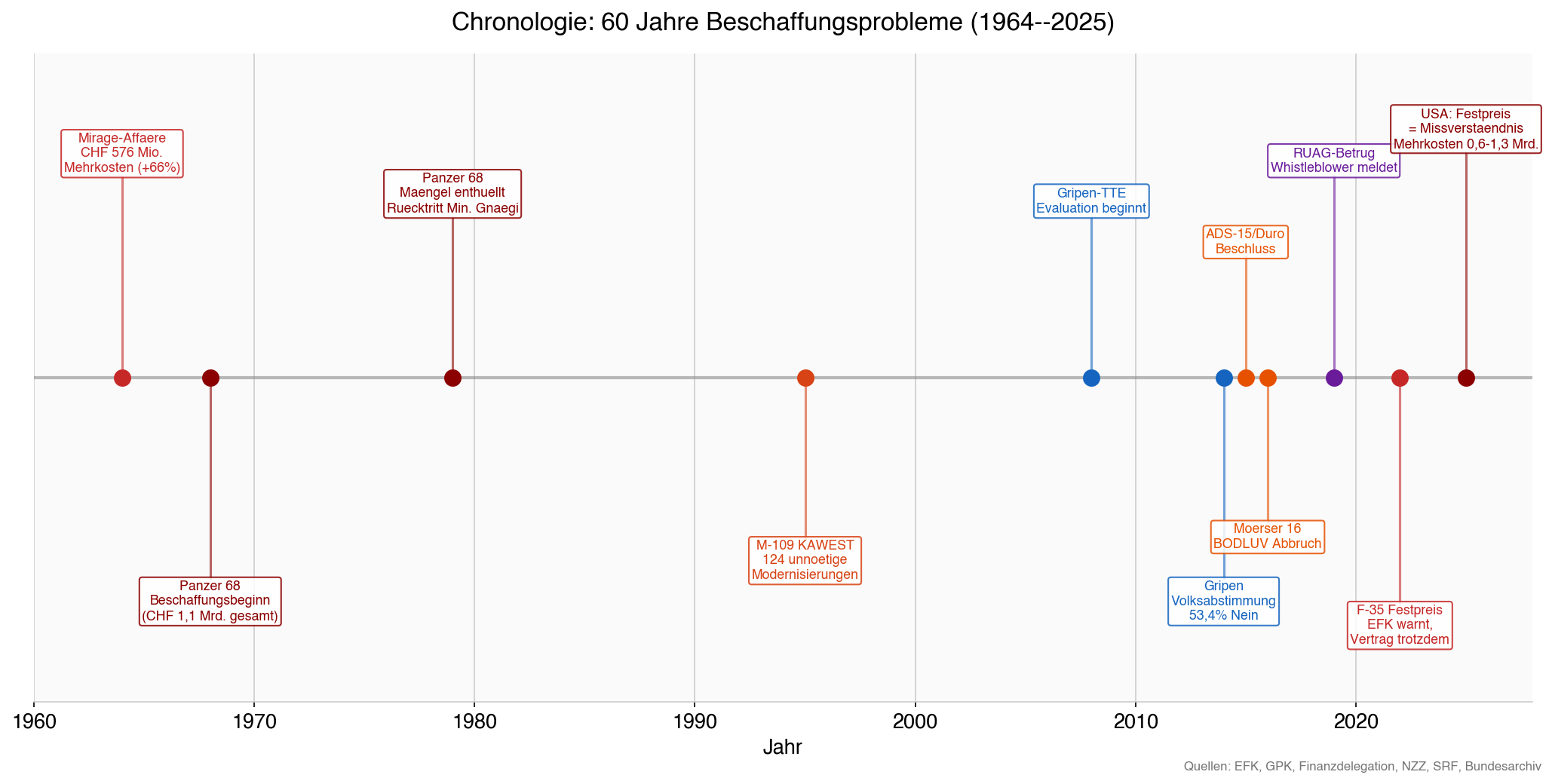
The procurement of 100 Dassault Mirage III S aircraft was approved by parliament in 1961 with a budget of CHF 871 million. In April 1964, the Federal Council was compelled to request a supplementary credit of CHF 576 million (+66%). [2] [3]
The causes lay in secret special requests by the air force, the costly domestic licence production in Switzerland, and the installation of American on-board electronics -- costs that had been concealed from parliament. [54]
Consequences: Parliament rejected the full supplementary credit and approved only CHF 150 million. The fleet was reduced from 100 to 57 aircraft. Switzerland's first parliamentary investigation commission was convened, Federal Councillor Paul Chaudet resigned, and Air Force Commander Primault was dismissed. [4] [54]
¶ Panzer 68 (1968--1979)
The Panzer 68 main battle tank was a domestic development by the Federal Construction Works in Thun. Between 1968 and 1979, a total of 390 tanks in various versions were procured for over CHF 1.1 billion. [53]
The procurement was driven primarily by industrial policy considerations. Defence Minister Nello Celio reportedly declared openly, as cited in the NZZ: «Ce n'est pas une nécessité militaire, c'est une nécessité industrielle!» [53]
In 1979, the Weltwoche revealed an internal situation report documenting serious technical defects: the cannon fired spontaneously when the heating was switched on; the NBC protection system was inadequate; and increasing the radio volume caused the turret to rotate. [53]
Consequences: Parliamentary investigation in 1979, resignation of Defence Minister Gnägi. The tanks remained in service despite their shortcomings until approximately 2005, after which they were scrapped owing to the lack of buyers.
¶ M-109 KAWEST: Over-Modernisation (1995)
In the 1990s, parliament approved approximately CHF 600 million for the modernisation (KAWEST programme) of 348 M-109 self-propelled howitzers. Army leadership already knew at the time of credit approval that, due to ongoing army reforms, only 224 systems would be required. Nevertheless, all 348 vehicles were modernised. [64]
The costs for the 124 unnecessarily modernised systems amount to approximately CHF 214 million -- taxpayers' money knowingly spent on equipment that was not needed.
¶ BODLUV 2020: Project Cancellation (2013--2016)
The project "Ground-Based Air Defence 2020" was intended to replace the ageing Rapier systems. The original master plan of 2013 envisaged CHF 500 million for a complete system. By 2015, rough cost estimates had already risen to over CHF 800 million. [55]
On 22 March 2016, Federal Councillor Parmelin suspended the entire project after SRF's Rundschau programme confronted him with internal information that, by his own account, he had not been aware of. [56]
The GPK (Parliamentary Oversight Committee) criticised the suspension decision as "factually and politically incomprehensible". [57] Sunk costs for evaluation preparations amounted to around CHF 20 million. More serious is the capability gap: following the decommissioning of the Rapier in 2022, Switzerland had no medium-range ground-based air defence.
¶ Failed Gripen Procurement (2008--2014)
In 2008, armasuisse began the evaluation for the partial Tiger replacement (TTE). Evaluation costs amounted to approximately CHF 8 million. In 2011, the type selection fell on the Saab Gripen E/F -- an aircraft that had never flown at that point in time. The Federal Council requested CHF 3.126 billion for 22 Gripen aircraft. [58]
On 18 May 2014, 53.4% of voters rejected the procurement in a popular referendum. The CHF 8 million in evaluation costs were thereby sunk costs. [58]
¶ Duro Overhaul (2015--)
In 2015, parliament approved CHF 558 million for the value retention of 2,200 Duro transport vehicles. The cost per vehicle, at over CHF 200,000, was significantly higher than the original acquisition price (~CHF 140,000). Critics argued that new procurement would have been cheaper. [60]
The manufacturer Mowag had itself produced the study showing "value retention" to be cheaper than new procurement -- a conflict of interest. [60] During the overhaul, the Austrian engine supplier Steyr Motors filed for insolvency; engines already installed had to be replaced. By mid-2020, only 40 of 2,200 vehicles had been delivered. armasuisse demanded "several million francs" in contractual penalties for the delays. [59]
¶ Mörser 16 (2016--)
In 2016, parliament approved CHF 404 million for 48 "Cobra" armoured mortar systems on a Piranha chassis. With additional orders, the total volume rose to approximately CHF 600 million. [63]
The SFAO criticised the absence of "genuine competition": only two systems were shortlisted (RUAG Cobra and Patria Nemo), and military requirements had been adjusted several times during the process "to favour the RUAG system". [61] [62]
The system has no enclosed turret -- the crew is exposed when firing. In light of drone warfare experience from the war in Ukraine, this is a serious disadvantage: the competing Finnish system Patria Nemo features an enclosed turret and can change position within 10 seconds of firing. [63] Deliveries commenced in 2024 -- seven years later than planned.
¶ Current Findings: SFAO, GPK and Finance Delegation
¶ F-35 Fixed Price: "estimated cost" vs. "fixed price"
In May 2022, the SFAO (Swiss Federal Audit Office) published audit report 21410 on the F-35 procurement contract. The central criticism: the "fixed price" of CHF 6.035 billion communicated by the DDPS lacked sufficient legal certainty within the framework of the US Foreign Military Sales (FMS) system. [5]
armasuisse sharply rejected the SFAO's criticism, describing the report as a threat to federal interests. [6] In September 2022, the contract was signed -- despite the outstanding legal questions. [7]
In February 2025, the US Defense Security Cooperation Agency (DSCA) informed Swiss authorities that the fixed price was, from the American perspective, a "misunderstanding": at the time of contract signing, no production contract between the USA and Lockheed Martin had existed for the Swiss F-35 slots. [8]
The former SFAO Director Michel Huissoud stated to SRF in June 2025 that armasuisse had had sufficient time following the SFAO warning to clarify the legal uncertainty. Instead, the contract had been concluded swiftly in order to pre-empt the "Stop F-35" popular initiative. [9]
The estimated additional costs amount to USD 650 million to 1.3 billion. [8]
armasuisse's position: armasuisse cited "over 40 years of FMS experience" and declared that the fixed price was contractually secured. [6]
¶ ADS 15 Drone (Hermes 900)
The procurement of the ADS 15 reconnaissance drone system began in 2008. The planned operational date was 2020; a realistic date is 2029 at the earliest. Parliament approved approximately CHF 250 million in 2015; total costs now stand at approximately CHF 300 million. [10] [11]
The SFAO criticised overambitious objectives, inadequate planning and insufficient risk management. The manufacturer Elbit is delivering late and not at the required quality. Five of six drones have been delivered; none is operationally capable. [11] [12]
A DDPS risk manager requested to be relieved of his function due to a lack of specialist knowledge -- without success. [13]
The Finance Delegation established that the project had been further delayed and made more expensive by "Swiss special requirements". [14]
¶ F-35 Hangars and Infrastructure
In 2018, a cost ceiling of CHF 120 million was established for F-35 infrastructure. The SFAO determined that costs would rise to over CHF 200 million; additional projects in excess of CHF 50 million were identified. The basis for the cost ceiling did not, according to the SFAO, meet the statutory requirements. [15] [16]
Building permits were delayed: Payerne by at least six months, Meiringen and Emmen by at least one year. [17]
¶ TKA Radio Devices (Tactical Army Communication System)
The total volume of the TKA procurement amounts to approximately CHF 1.6 billion. The planned completion by 2032 has been delayed by at least three years (earliest 2035). The manufacturer Elbit is delivering late and with quality deficiencies. Expected additional costs amount to approximately CHF 50 million. [36] [37]
¶ SIG Sauer P320 (Army Pistol)
According to an armasuisse insider, the SIG Sauer P320 failed the troop suitability test; only the Glock G45 met all mandatory criteria. The P320 had already been eliminated in the pre-evaluation. Chief of Armaments Urs Loher personally decided to reintroduce the pistol into the competition. [38]
DDPS/armasuisse's position: The identified shortcomings were "retrofittable adjustments". The choice of the P320 was based on domestic production, a price 20% lower, and armaments policy advantages. [39]
¶ Patriot Air Defence
In 2022, Switzerland ordered five Patriot systems for approximately CHF 2 billion (delivery 2026--2028). In July 2025, the USA informed Switzerland that Ukraine would be prioritised for Patriot deliveries. Of the CHF 2 billion, approximately CHF 650 million had already been transferred; Switzerland suspended its instalment payments. [40] [41]
The FMS contract conditions permit the USA to unilaterally adjust delivery priorities. As a consequence, the additional procurement of the Iris-T system from Diehl Defence (Germany) is being examined. [42]
¶ Project Management: CHF 19 Billion Portfolio
The Finance Delegation noted "with great concern" that the situation of armasuisse's key projects had "deteriorated noticeably". The total volume of the affected projects amounts to approximately CHF 19 billion. More transparent reporting and more realistic planning are called for. [14] [9]
¶ F-35 Evaluation (GPK-N)
The Parliamentary Oversight Committee of the National Council (GPK-N) published its report on the "New Combat Aircraft" evaluation procedure in September 2022. The central criticism: the DDPS and the Federal Council had defined the framework conditions in such a way that no room remained for foreign policy considerations. [18] [19]
Of the five recommendations made by the GPK-N, the Federal Council rejected one and regarded three as already fulfilled. [20] [21]
In July 2025, the GPK-N resolved to conduct a further inspection on the subjects of the fixed price and the DDPS's information policy. [22]
¶ Offset Controlling (GPK-S)
The Parliamentary Oversight Committee of the Council of States (GPK-S) established in January 2022 that the existing controlling of offset transactions (compensation transactions) did not permit any conclusions to be drawn about the achievement of objectives. Strategic goals such as technology access and competitiveness were not verifiable. The degree of digitalisation of the controlling was low, and DDPS oversight outside large projects was weak. [23] [24] [25]
¶ RUAG Scandal
A whistleblower reported fraud at RUAG to the DDPS General Secretariat in August 2019. The key statement was deleted from the internal response, and the report was subsequently "forgotten". [26]
A former RUAG employee had purchased Dutch tank spare parts for EUR 4.5 million in 2020 (NATO reference value: up to EUR 48 million). The SFAO identified 26 suspected cases of fraud. Between 2014 and 2023, 1,140 destructions and 1,319 inventory adjustments were carried out without army authorisation. [26] [27]
The GPK-S criticised oversight as having "failed at all levels". [28]
¶ Homburger Legal Opinion
On 27 April 2021, the DDPS awarded the law firm Homburger a mandate worth approximately CHF 550,000 (over CHF 500 per hour). The result: a 1.5-page opinion for the "plausibilisation" of the evaluation results. This was followed by a legal assessment of the "fixed price" concept -- dismissed by the USA as a "misunderstanding". [33] [34]
In total, over four years approximately CHF 2.5 million flowed to Homburger. The GPK criticised the dual role as both adviser and expert on the same subject matter. [35]
¶ Transparency and the Principle of Public Access
¶ Attempted Data Destruction Following Type Selection
SRF reported on 30 September 2021 that armasuisse had, following the type selection decision of June 2021, asked the unsuccessful bidders at closing meetings to destroy or return all data submitted -- before the parliamentary process had begun. All unsuccessful bidders confirmed this account. [29] [30]
armasuisse's position: The request had related exclusively to militarily classified data. [29]
¶ Federal Supreme Court and the Principle of Public Access
Two journalists (Tamedia, SRF) won a partial victory before the Federal Supreme Court: the court ruled that the exemptions from the principle of public access invoked by armasuisse and Empa were not applicable. The case concerned noise measurements from test flights and evaluation methods. [31] [32]
¶ Structural Patterns
Analysis of individual cases by the SFAO, the GPK and the Finance Delegation over six decades reveals five recurring patterns:
| Pattern | Evidence | Period |
|---|---|---|
| Lack of Contractual Expertise | Mirage: costs concealed from parliament; F-35: "fixed price" without US legal guarantee within the FMS system | 1964--2025 |
| Inadequate Risk Management | Panzer 68: known deficiencies ignored; ADS-15: risk manager requested to be relieved of role; quality risk management to be outsourced to three external firms from 2026 [43] | 1968--2037 |
| Systematic Cost Overruns | Mirage (+66%), M-109 (36% unnecessarily modernised), ADS 15 (+CHF 50 million), TKA (+CHF 50 million), F-35 fixed price (+USD 650 million--1.3 billion), hangars (+CHF 80 million) | 1964--2025 |
| Political Interference in Technical Decisions | Panzer 68: "nécessité industrielle"; P320: intervention by Chief of Armaments; Mörser 16: requirements adjusted; F-35: fixed price narrative despite SFAO warning | 1968--2025 |
| Structural Dependence on Manufacturers | RUAG fraud (26 cases); Elbit deficiencies (ADS 15 + TKA); Mowag conflict of interest (Duro); US delivery prioritisation (Patriot); unilateral FMS contract conditions | 2014--2025 |
These patterns extend across six decades and point to structural weaknesses that cannot be remedied by personnel changes alone. The cumulative balance of an estimated CHF 3.6 to 7.9 billion in today's prices underscores the need for reform.
¶ Negotiating Outcome in International Comparison: Finland
Switzerland and Finland selected the F-35A as their new combat aircraft almost simultaneously -- Switzerland in June 2021, Finland in December 2021. Both decisions were made within the framework of the US Foreign Military Sales (FMS) system. However, the publicly available contract terms reveal considerable differences in the negotiating outcomes.
¶ Comparison of Contract Conditions
| Aspect | Finland (64 F-35A) | Switzerland (36 F-35A) |
|---|---|---|
| Total budget | ~EUR 9.4 billion (EUR 10 billion framework) [45] | ~CHF 6.035 billion (~EUR 6.25 billion) |
| Price stability | Stable within the budget framework [46] | Additional costs of USD 650 million to 1.3 billion [8] |
| Fleet strength | 64 units unchanged [46] | Reduction of the planned 36 units announced [47] |
| Support until 2030 | Included in purchase price (EUR 2.92 billion) [45] | Initial spare parts and Initial Sustainment included in the credit; longer-term operating costs separate |
| Industrial depth | Patria: forward fuselage production for global supply chain; engine hub [48] [49] | RUAG: 4 final assemblies (RIGI project) |
| Data sovereignty | National servers + Insta Cross-Domain Solution [50] | Discussion only after the purchase decision |
| Mandatory offset quota | 30% (qualitatively deep integration) [51] | 60% (achievement of objectives not verifiable [23]) |
¶ Analysis of the Differences
The comparison reveals considerable differences in the negotiating outcomes for a comparable procurement subject:
-
Operating costs: The Finnish contract explicitly includes maintenance, spare parts and training until 2030 in the purchase price (EUR 2.92 billion) [45]. The Swiss procurement credit includes initial spare parts and Initial Sustainment, but not the longer-term operating costs.
-
Industrial integration: Finland's industrial participation goes beyond classic offset transactions: Patria produces F-35 forward fuselage sections for the global supply chain, making Finland a structurally indispensable partner in the programme [48]. The Swiss final assembly of 4 jets (RIGI project) does not create a comparable permanent position in the global supply chain.
-
Price stability: The Finnish programme is reportedly moving within the planned budget framework according to official statements [46]. In Switzerland, the additional costs communicated by the USA led the Federal Council to announce a reduction in fleet strength [47] [52].
-
Data sovereignty: Finland had already negotiated data sovereignty measures prior to contract signing, including national servers and a domestically developed Cross-Domain Solution [50]. In Switzerland, questions regarding dependence on US-controlled logistics systems only gained prominence after the purchase decision had been made.
Note: The differing outcomes must also be viewed against the background of different geopolitical frameworks: Finland shares a 1,300 km border with Russia and has been a NATO member since 2023, which is likely to have influenced its negotiating position vis-à-vis the USA.
For a detailed presentation of the Finnish F-35 programme and its budget structure, see: International Experiences. For a comparison of industrial participation models, see: Offset Transactions and Industrial Participation.
¶ Reform Approaches
For an analysis of international best practices and concrete reform models for Swiss defence procurement, see: Reform of Defence Procurement
On 20 June 2025, the Federal Council adopted its first Defence Procurement Strategy with 10 fields of action. [44] This partially addresses the identified problem areas, but does not touch the institutional structure of armasuisse.
¶ Bibliography
[1] armasuisse -- Organisation
[2] Federal Archives -- Pitfalls of an Aircraft Procurement: The Mirage Affair
[3] Dodis -- Beginning of the Mirage Affair 1964
[4] Historical Dictionary of Switzerland -- Mirage Affair
[5] SFAO Audit Report 21410 -- F-35 Fixed Price (PDF)
[6] SRF -- Federal Audit Office and armasuisse dispute F-35 price
[7] SRF -- F-35: When the fixed price becomes a matter of faith
[8] NZZ -- Fixed price for F-35: why the USA speaks of a misunderstanding (25.6.2025)
[9] SRF -- Former SFAO Director on F-35 purchase (27.6.2025)
[10] SFAO -- Audit of ADS 15 Drone System
[11] Aargauer Zeitung -- Sharp criticism from Federal Audit Office over troubled ADS 15 drone
[12] SRF -- No operationally capable drones
[13] 20 Minuten -- DDPS risk manager requested dismissal due to lack of expertise (2024)
[14] NZZ -- Drone project in crisis due to Swiss special requirements
[15] 20 Minuten -- Federal Audit Office warns of costs and delays for F-35 hangars
[16] Moneycab -- Federal Audit Office criticises handling of credit for combat aircraft infrastructure
[17] SRF -- Are the military airfields ready when the first F-35 arrives?
[18] GPK-N -- Inspection of the New Combat Aircraft evaluation procedure (July 2025)
[19] Jungfrau Zeitung -- Oversight criticises lack of room for manoeuvre (2022)
[20] SRF -- Federal Council responds to objections regarding combat aircraft procurement
[21] Tages-Anzeiger -- Federal Council rejects criticism of F-35 procurement procedure
[22] GPK-N -- Inspection on fixed price and information policy (1.7.2025)
[23] GPK-S -- Report on Offset Controlling (PDF, 25.1.2022)
[24] NZZ -- Nobody knows what offset transactions really bring Switzerland
[25] Aargauer Zeitung -- Committee wants to strengthen oversight of compensation transactions
[26] SRF -- RUAG fraud case: Federal Council oversight was "hair-raising"
[27] NZZ -- Federal Audit Office dissects RUAG and reveals failures at all levels
[28] Tages-Anzeiger -- Parliamentary oversight criticises Confederation over tank sale
[30] SRF -- Destruction of combat aircraft files: what the law says
[31] SRF -- Federal Supreme Court overturns decisions on F-35 documents
[32] Blick -- Partial victory before Federal Supreme Court against armasuisse
[33] NZZ -- The lawyers of Homburger and their disputed role in the combat aircraft purchase (19.7.2025)
[34] Tages-Anzeiger -- Useless legal opinions for the F-35
[35] Blick -- Amherd's hidden legal costs revealed: CHF 2.5 million for Zurich F-35 lawyers
[36] NZZ -- The army's new radio devices are also arriving late and costing more
[37] Tages-Anzeiger -- Radio devices, mortars, Duros: yet more problem areas in the army (17.2.2025)
[38] 20 Minuten -- armasuisse insider: new Swiss pistol failed the test (6.12.2025)
[39] NZZ -- Chief of Armaments Urs Loher on the new army pistol
[40] SRF -- Switzerland must wait longer for its ordered Patriot missiles
[41] Tages-Anzeiger -- Patriot missiles: Switzerland suspends payments to USA
[42] NZZ -- Switzerland receives its Patriots late: a clear signal from the USA
[43] SRF -- Why external consultants will oversee armaments in future (28.8.2025)
[44] DDPS -- Federal Council Defence Procurement Strategy (June 2025)
[45] Finnish Government -- F-35A Announcement (10.12.2021)
[46] Finnish Government -- Review of F-35 Programme Status
[47] Breaking Defense -- Switzerland reduces F-35 buy after $610 million price hike (12/2025)
[48] EDR Magazine -- Patria: Significant role in F-35 supply chain
[49] Defense News -- Finland approves construction of Patria's F-35 assembly facility (3/2024)
[50] Insta -- DomainLink Secret Cross-Domain Solution
[51] Air & Space Forces Magazine -- Finland Formalizes Deal for 64 Block 4 F-35s (2/2022)
[52] SWI swissinfo.ch -- Switzerland to buy fewer F-35 fighter jets (12/2025)
[53] NZZ -- The troubled tank from Switzerland
[55] SFAO -- Ground-Based Air Defence 2020 project
[56] SRF -- Bodluv debacle: Federal Councillor Parmelin in a poor light
[57] Tages-Anzeiger -- Parmelin's Bodluv decision incomprehensible
[58] SRF -- Gripen rejected by voters (18.5.2014)
[59] Aargauer Zeitung -- Duro delayed: army demands millions in penalties
[60] SRF -- Mowag: beneficiary of the disputed Duro overhaul
[61] NZZ -- Mortar: requirements changed, no genuine competition
[62] Swissinfo -- Federal Audit Office criticises mortar procurement procedure
[63] 20 Minuten -- CHF 600 million for highly vulnerable mortars (2024)
[64] Tages-Anzeiger -- Artillery fighting with 60-year-old tanks
[65] FSO -- Swiss Consumer Price Index (Inflation Calculator)
Further References: