¶ Defence Procurement Reform -- A Vision
The lessons from six decades of Swiss defence procurement speak a clear language: what Switzerland needs is not another internal reorganisation within the DDPS, but an institutional break -- an independent, professionally autonomous procurement authority modelled on FINMA or ENSI. This page analyses international best practices, formulates ten criteria for a modern procurement authority, and presents a concrete organisational structure.
Note: In addition to documented facts, this page contains the author's own analysis and conclusions, which are marked as such. The proposed organisational structure is a contribution to the discussion, not a definitive solution. For the detailed analysis of weaknesses in the current armasuisse, see armasuisse Weaknesses.
¶ 1. Why an Institutional Break Is Necessary
¶ 1.1 Six Decades of Failed Internal Reforms
Since the Mirage affair of 1964, Switzerland has undergone numerous reorganisations of its defence procurement: Kriegstechnische Abteilung (KTA) → Gruppe für Rüstungsdienste (GRD) → Federal Office for Defence Procurement → armasuisse (2004). Each of these reforms operated within the same institutional framework: an administrative unit subordinate to and bound by directives from the DDPS [1].
The reports of the Swiss Federal Audit Office (EFK), the Control Committees (GPK) and the Parliamentary Control of the Administration (PVK) have documented the same structural patterns for decades: lack of contract expertise, cost overruns, insufficient evaluation independence, and political interference in technical decisions [2] [3]. For a detailed analysis of these weaknesses, see armasuisse Weaknesses.
The Federal Council's armaments policy strategy of June 2025 addresses ten fields of action but does not tackle the institutional foundation [4]. It continues to operate within the existing framework -- armasuisse as a directive-bound federal office within the DDPS.
¶ 1.2 The Fundamental Problem: armasuisse in the Four-Circle Model
The Four-Circle Model of federal corporate governance (Federal Council report 2006) distinguishes four circles of increasing autonomy [5]:
- Circle 1 -- Core Administration: Federal offices directly within the line organisation
- Circle 2 -- FLAG/NFB Units: Administrative units with extended autonomy (performance mandate, global budget), but bound by directives
- Circle 3 -- Autonomous Entities: Public-law institutions with their own legal personality (FINMA, ENSI, Swissmedic)
- Circle 4 -- Federal Enterprises: Corporations owned by the Confederation (SBB, Post, Swisscom)
armasuisse operates in Circle 2 -- with a performance mandate and global budget, but without its own legal personality, without its own personnel law, and without its own supervisory body. The head of the DDPS has full directive authority [6].
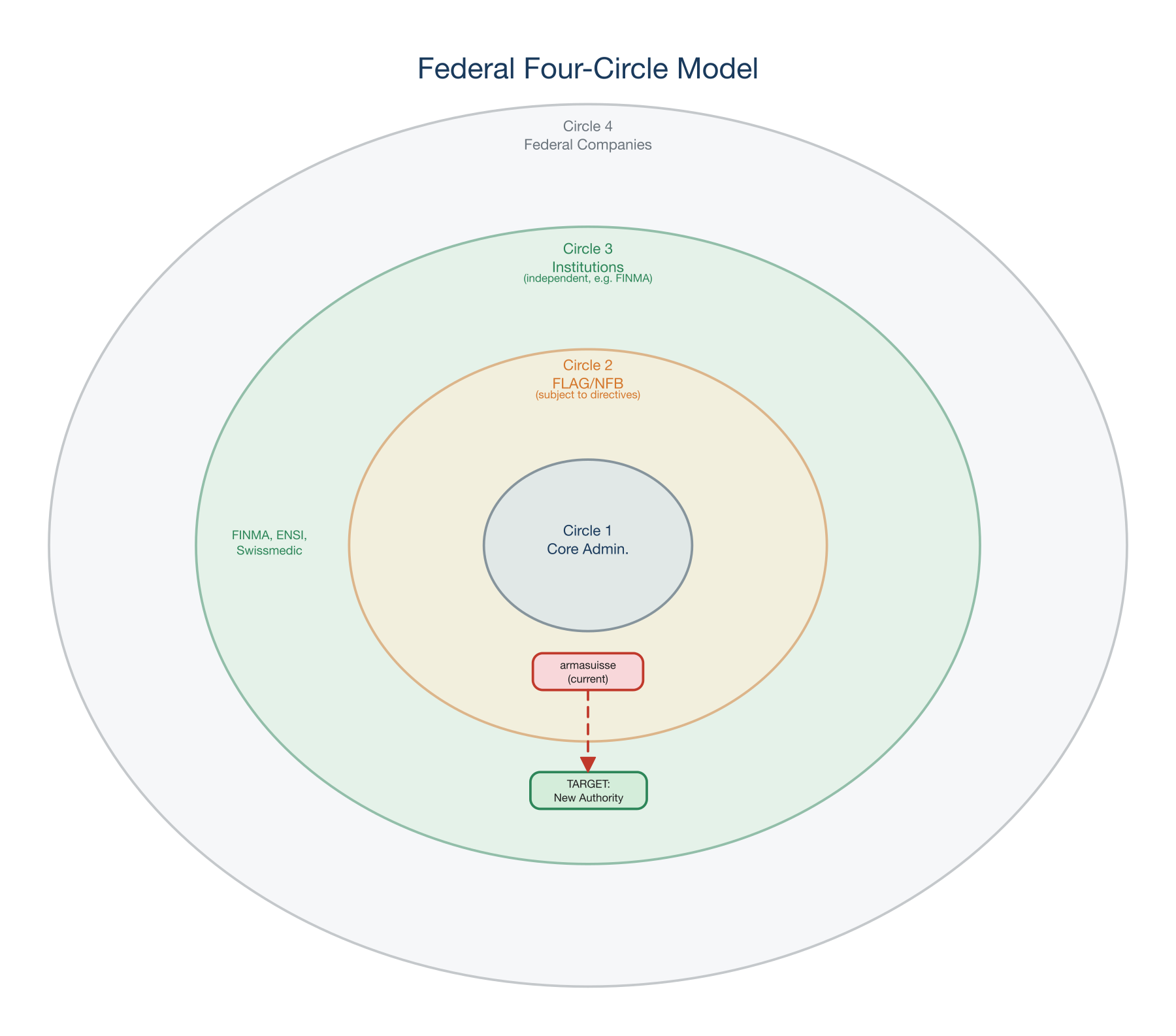
Four-Circle Model: armasuisse (Circle 2) should be transferred to Circle 3 -- the same institutional level as FINMA, ENSI and Swissmedic.
¶ 1.3 What Has Not Worked So Far
Author's analysis: The reform approaches to date can be divided into four categories, all of which operate within the existing institutional framework:
- New specifications and processes: Formal regulations do not change the fundamental structure of directive dependency.
- Additional controlling bodies: More control within the same system creates additional bureaucracy, not more independence.
- Further EFK reports: The EFK can only audit and recommend; implementation lies with the DDPS itself.
- Federal Council's armaments policy strategy (June 2025): Addresses symptoms (10 fields of action), not the institutional root cause [4].
¶ 2. International Comparison: How Other Countries Do It
A look beyond the national borders shows that numerous states have institutionally separated their defence procurement from the armed forces. The following overview is based on official government agency websites and the Library of Parliament Canada report [7].
¶ 2.1 South Korea: DAPA -- The Civilian Revolution (2006)
The Defense Acquisition Program Administration (DAPA) was established in 2006 as an independent authority to centralise procurement previously handled by the individual service branches. Over 70 per cent of its staff are civilians -- a deliberate break with the military-dominated tradition. DAPA manages a procurement budget of over 7 trillion KRW (2024) [8].
¶ 2.2 Sweden: FMV -- The Model for Small States
The Försvarets materielverk (FMV) is Sweden's procurement authority with approximately 1,200 employees and a contract volume of 68.3 billion SEK (2024). The Swedish constitution prohibits ministers from intervening in operational decisions of government agencies (ministerial ban). The separation between client (Försvarsmakten, the armed forces) and contractor (FMV) is institutionally anchored [9] [10].
¶ 2.3 UK: DE&S -- Arm's Length with Its Own Pay Structure
Defence Equipment & Support (DE&S) employs approximately 10,000 staff and manages an annual budget of 12.2 billion GBP (2024/25). As an Executive Agency of the Ministry of Defence, DE&S operates on an arm's-length basis with its own board and its own pay structure. According to its 2024/25 Annual Report, DE&S was able to maintain or come in under budget on 97 per cent of projects [11] [12].
¶ 2.4 France: DGA -- The Engineering Corps
The Direction générale de l'armement (DGA) employs approximately 10,100 staff, of whom 60 per cent are engineers. It has its own test centres and operates lifecycle management across the entire service life of systems. The DGA is a central directorate within the Ministry of Defence, but holds a de facto strong position through its technical expertise [13] [14].
¶ 2.5 Australia: DDA -- The Most Recent Reform (December 2025)
In December 2025, Australia announced the largest reform of its defence procurement in over 50 years: the existing CASG will be transformed into an independent Defence Delivery Authority (DDA), which is to operate as a Non-Corporate Commonwealth Entity (fully operational from 2027). A newly created National Armaments Director reports directly to the Minister for Defence [15].
¶ 2.6 Canada: DIA -- The Ongoing Transformation (October 2025)
Canada established the Defence Investment Agency (DIA) in October 2025 as an independent authority to replace the previous, heavily criticised system. The BUILD-PARTNER-BUY Framework prioritises Canadian industrial participation. The legislative basis is expected for spring 2026 [16] [17].
¶ 2.7 Negative Examples
Germany -- BAAINBw: The Federal Office of Bundeswehr Equipment, Information Technology and In-Service Support employs approximately 10,000 staff but suffers from 17 per cent vacancies and chronic delays. Despite its size, it remains a federal office, subordinate to the BMVg and bureaucratically embedded.
Netherlands -- COMMIT: The Materiel and IT Command, established in 2023, is organisationally part of the Ministry of Defence with limited autonomy [18].
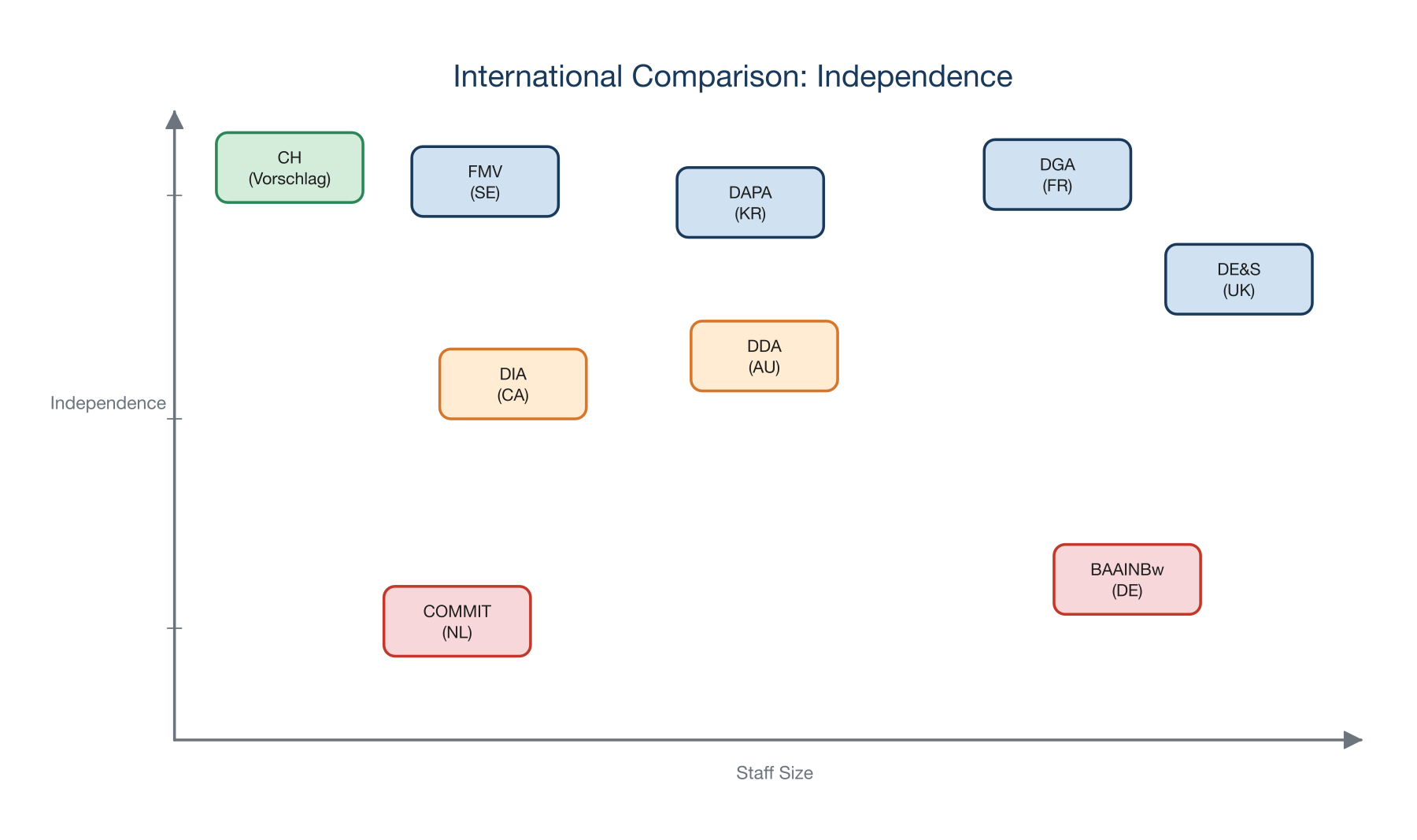
Scatter plot: The more independent the procurement authority, the clearer the separation between client and procurer (green). The Swiss proposal aims for the highest independence.
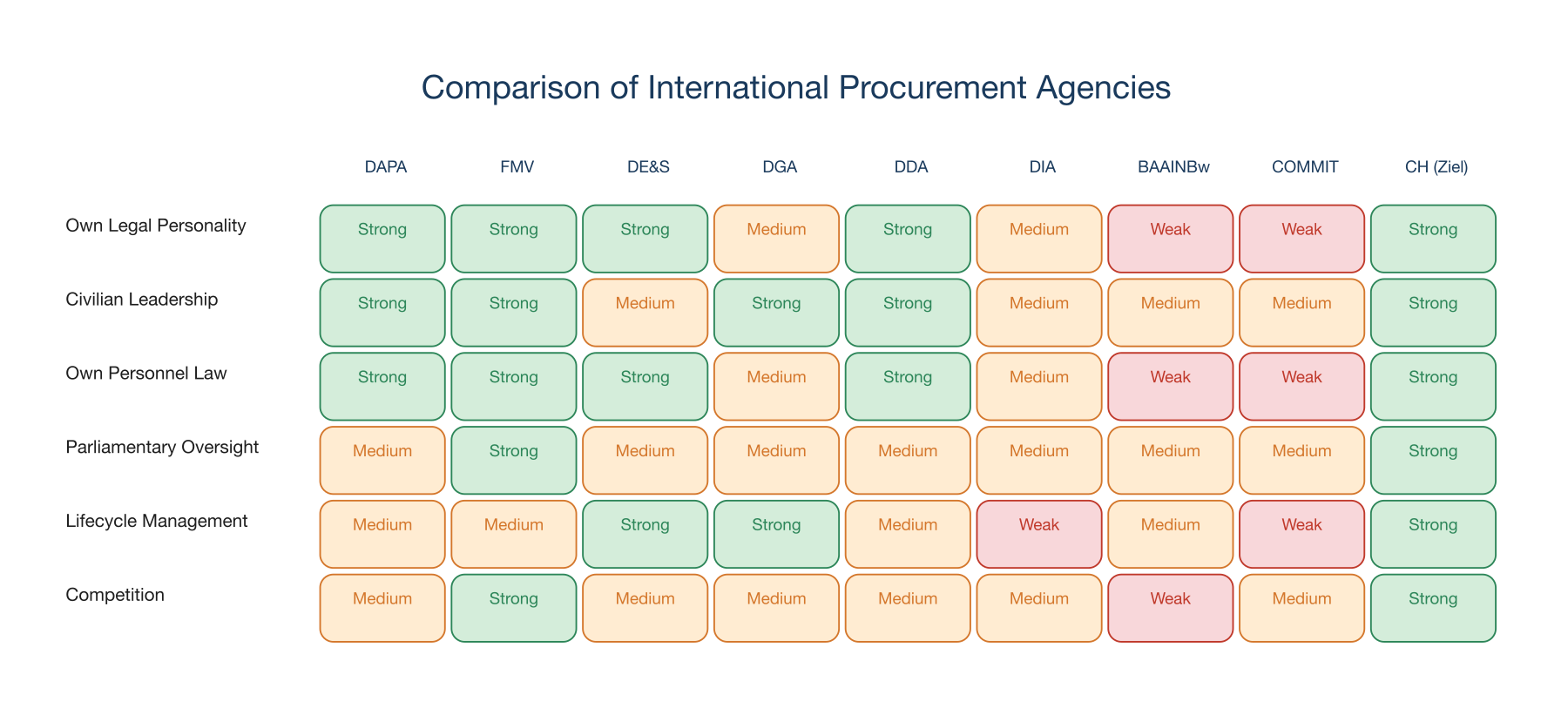
Colour matrix: Assessment of the 7+2 procurement authorities against six key characteristics. Green = strong, Yellow = medium, Red = weak.
¶ 3. Ten Criteria for a Modern Procurement Authority
Author's analysis: From international research and the practice of successful procurement authorities, ten core criteria can be derived. These serve as an analytical benchmark for assessing today's armasuisse and the proposed new authority.
| No. | Criterion | Description | Reference |
|---|---|---|---|
| 1 | Institutional Independence | Separation of user (armed forces) and procurer; no directive dependency in technical decisions | OECD Principles [19], FINMA/Swissmedic as Swiss models |
| 2 | Technical Competence | Own engineering corps with specialist expertise in systems engineering, contract law and programme management | DGA France (60% engineers) [13], FMV Sweden [9] |
| 3 | Lifecycle Cost Control | Total cost assessment over the lifecycle, not just acquisition price | UK DE&S [11] |
| 4 | Transparency and Anti-Corruption | Systematic disclosure of procurement decisions, costs and timelines | Transparency International Defence Index [20] |
| 5 | Parliamentary Oversight | Specialised procurement oversight with technical competence | PVK Report [2] |
| 6 | Competition Promotion | Open tenders as the rule; invitation procedures as a justified exception | OECD Principles [19] |
| 7 | Innovation Promotion | Risk budgets for new technologies; prototyping and spiral development | UK DASA |
| 8 | Interoperability | NATO standards (STANAGs) as tender requirements | NATO Standardization Office |
| 9 | Speed | Maximum five years from project start to first delivery for standard procurements | UK Integrated Procurement Model |
| 10 | Personnel Management | Competitive salaries; rotation between administration and industry | DE&S Trading Entity [11], DGA Corps [13] |
¶ Assessment: armasuisse vs. Ideal Organisation
| No. | Criterion | armasuisse Today | Ideal Organisation |
|---|---|---|---|
| 1 | Institutional Independence | 1 -- Directive-bound (Circle 2) | 5 -- Own legal personality (Circle 3) |
| 2 | Technical Competence | 2 -- Limited | 5 -- Own engineering corps (DGA model) |
| 3 | Lifecycle Cost Control | 2 -- Focus on acquisition price | 4 -- TCO as standard method |
| 4 | Transparency | 2 -- Regularly criticised by EFK | 4 -- Systematic disclosure |
| 5 | Parliamentary Oversight | 2 -- SiK with limited access | 5 -- Direct accountability |
| 6 | Competition Promotion | 2 -- 97% outside WTO rules (PVK 2007) | 4 -- Open tender as the rule |
| 7 | Innovation Promotion | 2 -- No dedicated risk budget | 3 -- Innovation division |
| 8 | Interoperability | 3 -- Partially NATO-compatible | 4 -- STANAGs as mandatory criterion |
| 9 | Speed | 1 -- Systematic delays | 3 -- Target: max. 5 years standard |
| 10 | Personnel Management | 2 -- BPG pay grades | 5 -- Own personnel law |
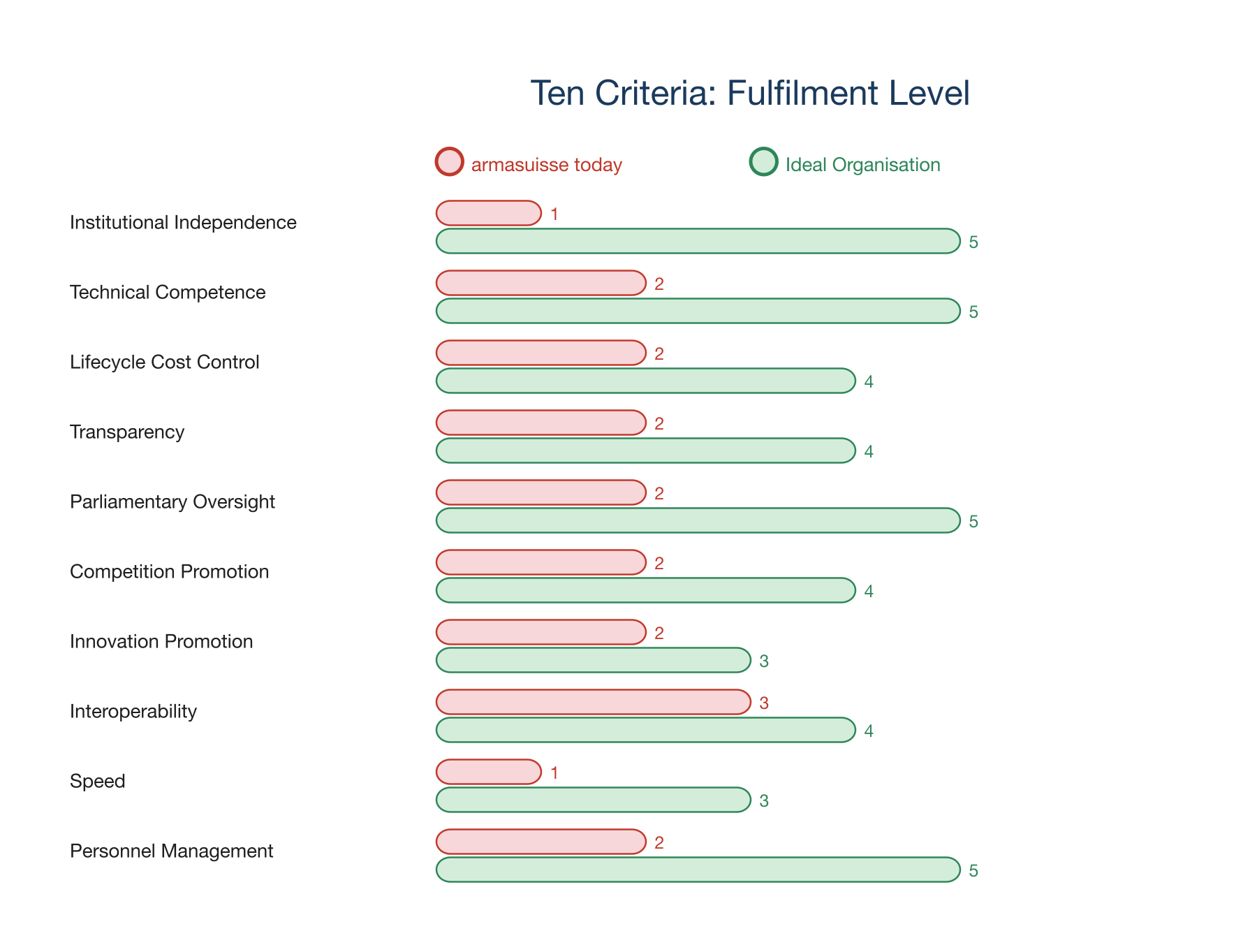
Horizontal bar chart: armasuisse's average is 1.9 out of 5 points, the ideal organisation scores 4.2. The largest gaps exist in independence, speed and personnel management.
¶ 4. Five Core Principles of the Ideal Organisation
Author's analysis: The ten criteria are condensed into five actionable core principles for the Swiss context.
| Principle | Description | International Model | Swiss Legal Framework |
|---|---|---|---|
| 1. Institutional Independence | Independent federal authority, not subordinate to the DDPS | FMV Sweden (ministerial ban) [9] | Public-law institution (Circle 3), analogous to FINMA/ENSI [21] [22] |
| 2. Separation of Client/Procurer | Armed forces define requirements, authority procures | FMV vs. Försvarsmakten (SE), MOD vs. DE&S (UK) | Special law analogous to ENSIG |
| 3. Personnel Independence | Own specialist staff (engineers, lawyers, economists) | DGA (60% engineers) [13], DAPA (70% civilians) [8] | Own personnel law (analogous to FINMA Personnel Ordinance) [23] |
| 4. Freedom from Political/Military Pressure | Evaluations without predetermined outcomes | OECD Principles [19] | Incompatibility rules for the authority board |
| 5. Parliamentary Control | Specialised oversight with document access | EFK (budget directly from Parliament) [24] | Strengthened SiK or new procurement oversight |
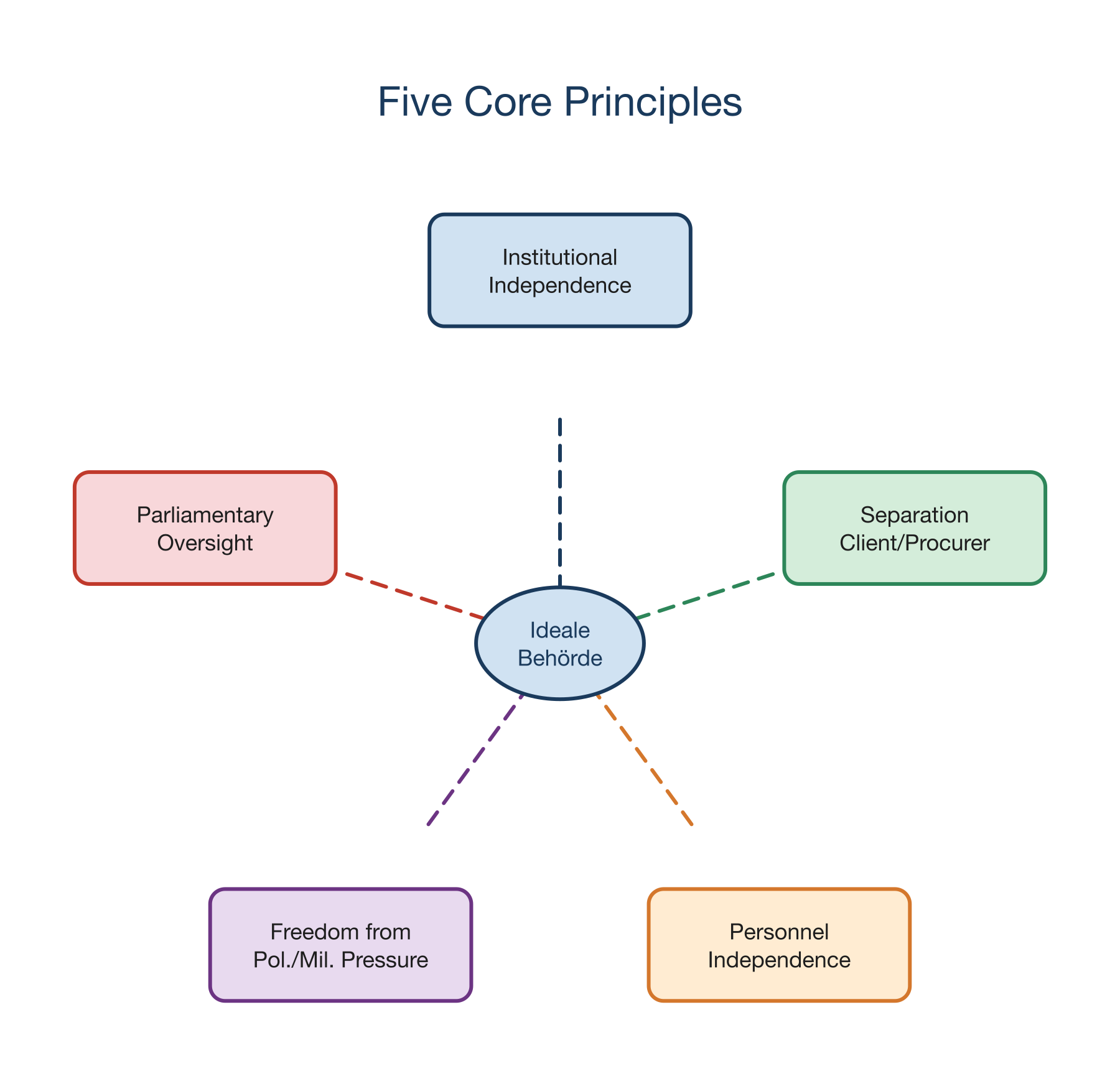
Radar chart: The five core principles compared. armasuisse (red) does not exceed 2 out of 5 points on any principle.
¶ 5. Proposed Organisational Structure
¶ 5.1 Legal Form: Public-Law Institution (Circle 3)
Author's analysis: The proposed legal form is the public-law institution -- the same legal form as FINMA (FINMAG, SR 956.1) [21], ENSI (ENSIG, SR 732.2) [22] and Swissmedic (HMG, SR 812.21) [25]. This legal form offers:
- Own legal personality: The authority can enter into contracts, hire personnel and appear in court in its own name.
- Operational independence: The Federal Council sets strategic objectives (4-year cycle) but does not intervene in operational decisions.
- Democratic control: An authority board (analogous to the FINMA Board of Directors) supervises management; Parliament exercises supreme oversight.
- Own personnel law: Competitive specialist salaries outside the BPG pay grades (analogous to the FINMA Personnel Ordinance [23]).
¶ 5.2 Governance Structure
Authority Board (7-9 specialist experts):
- Appointed by the Federal Council, independent
- Fields of expertise: engineering, contract law, technology assessment, financial controlling, international procurement
- Strict incompatibility rules: no active connections to the defence industry
- Model: FINMA Board of Directors [26], ENSI Board [27]
Executive Management (CEO + Division Heads):
- Operational management
- Professionally qualified (engineers, lawyers, economists)
Parliamentary Oversight Commission:
- Specialised procurement oversight (not just budget approval)
- Access to contract documents, evaluation reports, cost developments
- Model: Finance Delegation of the Federal Chambers
¶ 5.3 Organisational Divisions
The authority is divided into five specialist divisions and staff functions:
- Evaluation and Competition: Market analyses, tenders, type evaluations
- Contracts and Procurement Law: Contract negotiations, legal compliance, offset agreements
- Technology Assessment and Systems Engineering: Technical review, system integration, testing
- Lifecycle Cost Management: Total Cost of Ownership, operating cost forecasts, service life planning
- International Cooperation and Offset: Government-to-government agreements, multilateral programmes, industrial participation
Staff Functions: Legal, Compliance, Communications
¶ 5.4 Personnel Strategy
- Own personnel law (analogous to the FINMA Personnel Ordinance [23])
- Competitive salaries for specialists (engineers, contract lawyers, technology assessors)
- Fixed-term rotation between authority and industry (3-5 years) with cooling-off periods
- Specialised training (analogous to the DGA engineering corps [13], UK Defence Academy of the United Kingdom)
- Model: DE&S Trading Entity [11], DAPA civilian quota [8]
¶ 5.5 Financing
- Budget via procurement credits from Parliament (armaments programme)
- Operating costs of the authority as administrative expenditure
- Difference from FINMA self-financing: the procurement authority is not a regulator that levies fees
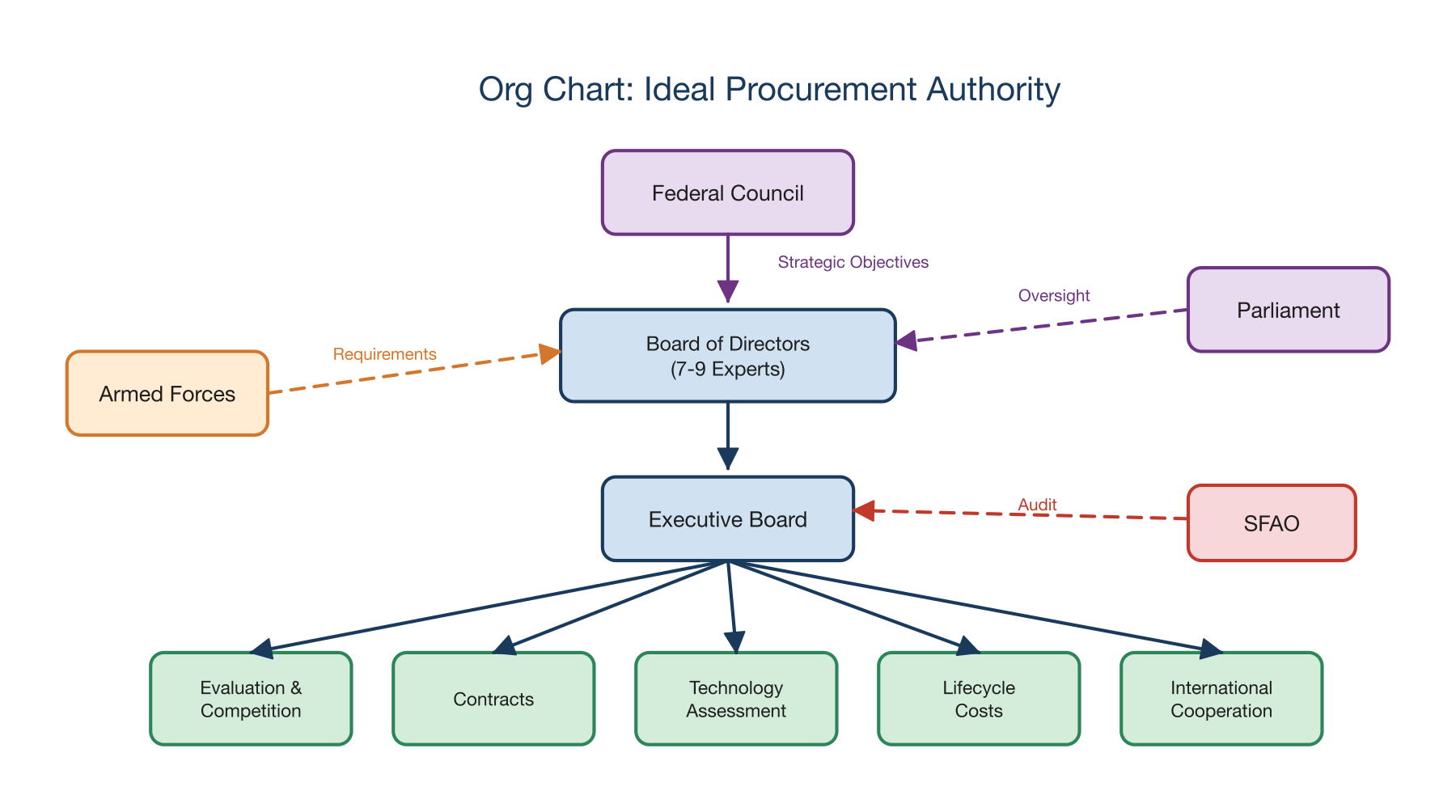
Organisation chart: The new authority is subordinate to the Federal Council (strategic objectives), not the DDPS. The armed forces provide requirements but have no influence on evaluations.
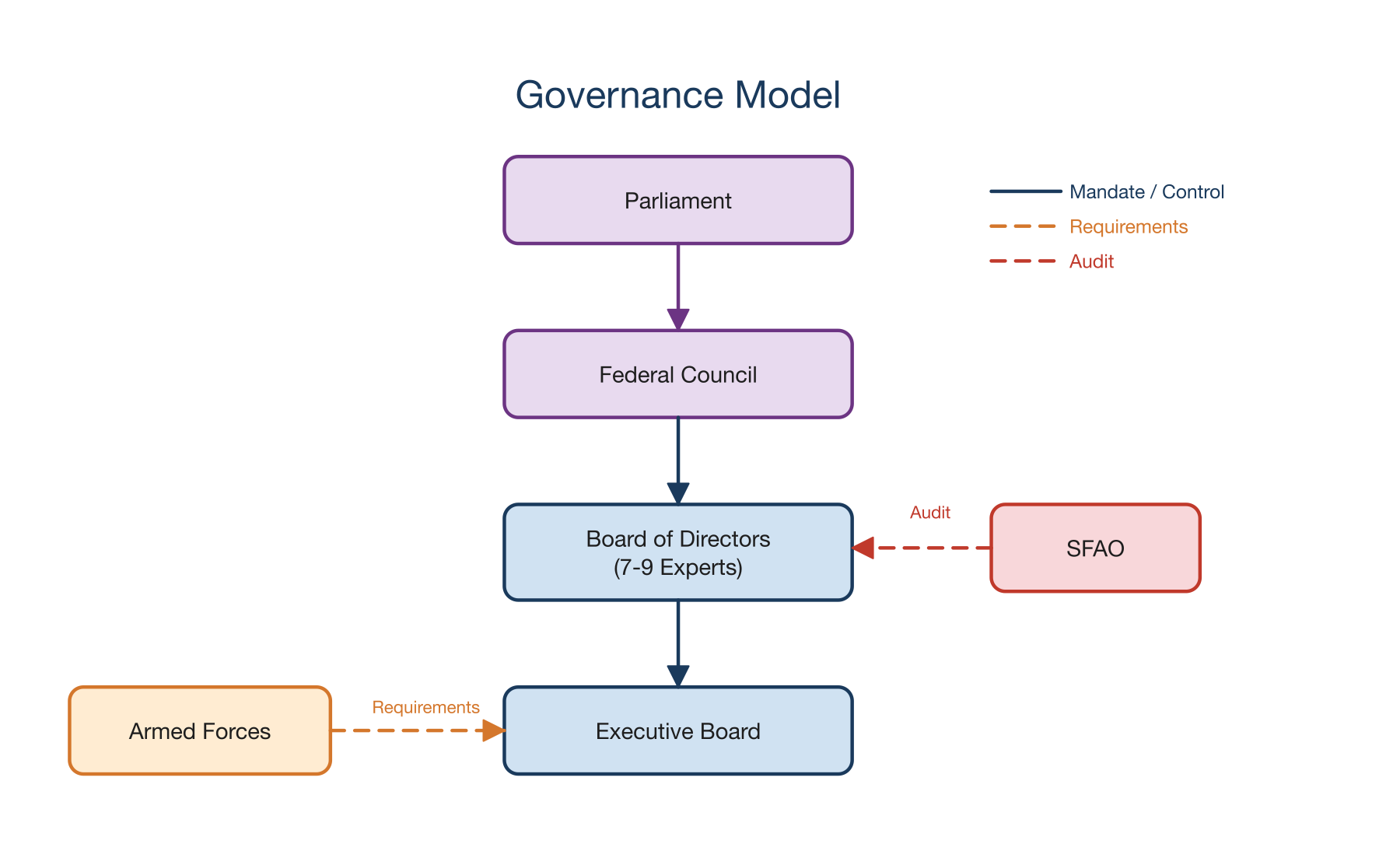
Governance model: Flow chart of responsibilities. Blue = mandate/control, Green = delivery/information, Red = audit (EFK), Orange = requirements (armed forces).
¶ 6. Rationale for Design Decisions
¶ 6.1 Why a Public-Law Institution?
Author's analysis: The three legal forms compared:
| Criterion | FLAG (Circle 2) | Institution (Circle 3) | Corporation (Circle 4) |
|---|---|---|---|
| Independence | Low (directive-bound) | High (own legal personality) | Very high |
| Democratic Control | Full (via department) | High (via authority board + Parliament) | Limited (via board of directors) |
| Personnel Flexibility | None (BPG) | High (own personnel law) | Very high |
| Risk of Excessive Autonomy | None | Low (authority board as control) | High (cf. RUAG) |
| Implementation Time | 6-12 months | 3-5 years | 5-7 years |
| Parliamentary Decision | No (Federal Council ordinance) | Yes (federal law) | Yes (special law) |
| Suitability | Insufficient | Optimal | Over-dimensioned |
ENSI as Precedent: ENSI was created in 2009 by transforming the former Main Division for the Safety of Nuclear Installations (HSK) -- a service unit subordinate to the Federal Office of Energy -- into an independent public-law institution [22]. This is exactly the same structural transformation proposed for armasuisse.
¶ 6.2 Why Separation of Client and Procurer?
The PVK report of 2007 documented the lack of a coherent procurement strategy as a direct consequence of the institutional intertwining of the armed forces and procurement [2]. Internationally, Sweden (FMV vs. Försvarsmakten), the UK (MOD vs. DE&S), Australia (DDA) and South Korea (DAPA) all demonstrate a clear institutional separation.
¶ 6.3 Why Engineers Instead of Officers?
The DGA model shows: 60 per cent engineers reduce manufacturer dependency and enable independent technical assessment [13]. DAPA explicitly adopted a 70 per cent civilian quota as a reform measure when it was established in 2006 [8].
¶ 6.4 Why Direct Parliamentary Control?
The Security Policy Committee (SiK) currently has only limited access to evaluation documents. Specialised procurement oversight -- analogous to the Finance Delegation -- with technical expertise would strengthen democratic control. Model: The EFK (Swiss Federal Audit Office) receives its budget directly from Parliament and is not bound by directives [24].
¶ 6.5 Why Particularly Suitable for Switzerland?
Author's analysis:
- Existing legal models: FINMA, ENSI and Swissmedic demonstrate that public-law institutions function within the Swiss legal system and are democratically legitimised [5].
- Direct democracy: The popular initiative provides a constitutional instrument to push through such a reform even against political resistance.
- Militia system: An independent specialist authority with full-time experts is a necessary counterweight to the militia parliament, which reaches the limits of its competence in highly complex defence procurements.
- ENSI precedent: The transformation of the HSK into ENSI (2007-2009) shows that such a transformation is feasible under Swiss federal law and leads to a functioning independent authority [22].
¶ 7. Advantages over the Status Quo
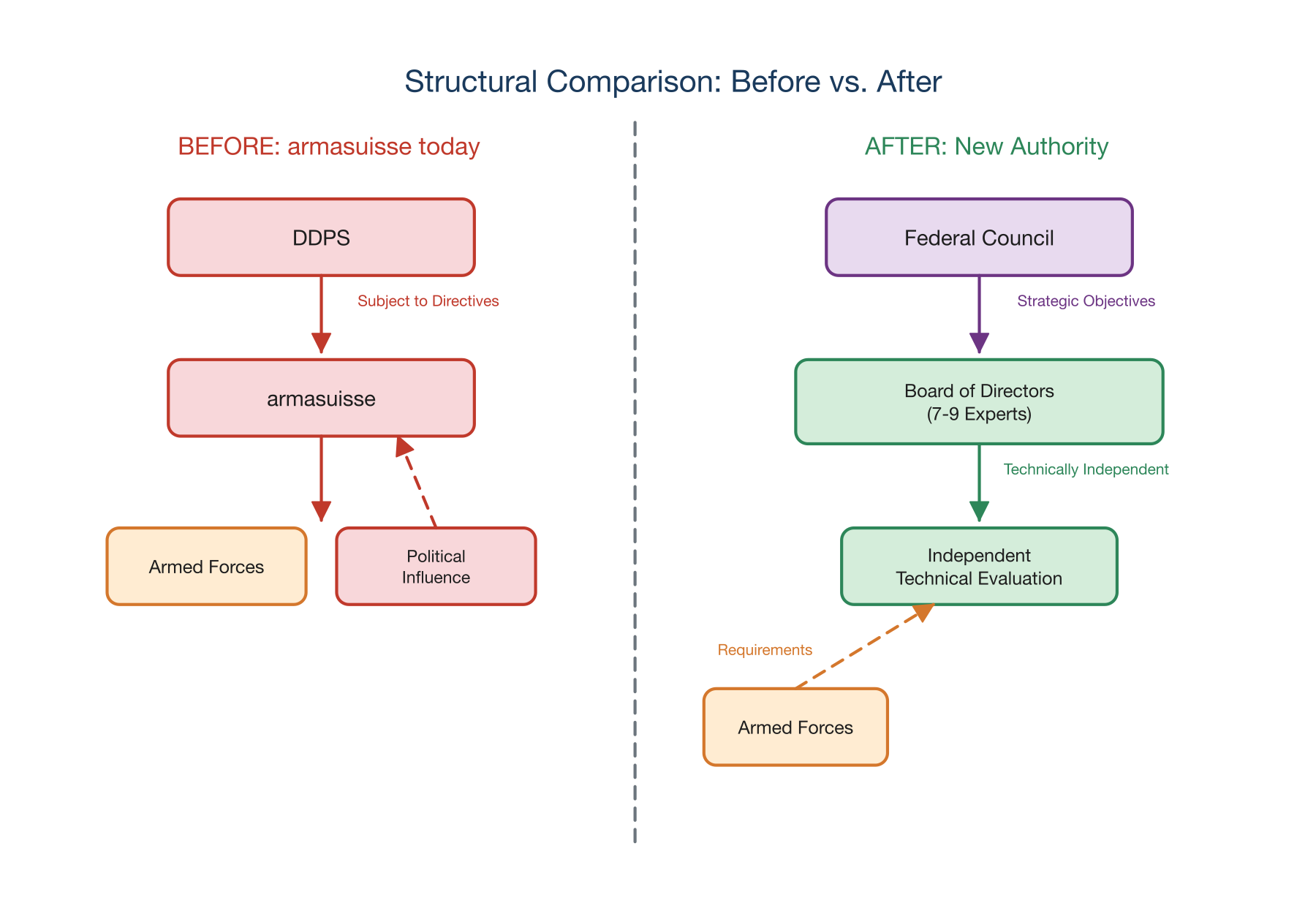
Before and after: On the left, the current state (directive authority of the department head, political interference); on the right, the proposed structure (independent specialist authority, armed forces only as requirements provider).
| Dimension | armasuisse Today | Ideal Organisation |
|---|---|---|
| Legal Form | Federal office (Circle 2) | Public-law institution (Circle 3) |
| Subordination | DDPS department head | Federal Council (strategic), authority board (operational) |
| Directive Dependency | Yes (politically steerable) | No (professionally independent) |
| Own Legal Personality | No | Yes |
| Personnel Law | Federal Personnel Act | Own personnel law |
| Pay Flexibility | BPG pay grades | Market-rate specialist salaries |
| Authority Board | None | 7-9 independent specialist experts |
| Parliamentary Oversight | Indirect (via DDPS) | Direct (accountability report) |
| Client-Procurer Separation | Formal, not institutional | Institutionally anchored |
| Evaluation Independence | Politically influenced | Professionally independent |
¶ Expected Improvements
Author's analysis, based on international benchmarks:
- Schedule adherence: FMV Sweden as benchmark for small states [9]
- Cost accuracy: DE&S UK achieved 97% budget adherence [11]
- Competition intensity: OECD Principle 3 calls for open access to procurement markets [19]
- Transparency: Systematic disclosure to TI Defence Index standards [20]
- Personnel quality: DGA engineering corps as benchmark for technical competence [13]
¶ 8. Context and Limitations
¶ 8.1 What the Model Does Not Solve
Author's analysis: An institutional reform of the procurement authority does not solve all problems:
- Fundamental question: Which defence equipment Switzerland needs remains a political decision.
- Industrial policy: The balance between domestic production and best-value procurement is a political trade-off that cannot be delegated to a specialist authority.
- Neutrality policy: ITAR restrictions and the country-of-origin principle constrain the selection regardless of the organisational form.
¶ 8.2 Challenges in Implementation
- Resistance from the DDPS and the armed forces: Autonomisation means loss of competence for the department.
- Personnel recruitment: Competition with the private sector for engineers and technology experts.
- Transition phase: Parallel operation of armasuisse and the new authority for 2-3 years.
- Finding a political majority: A federal law requires a majority in both chambers.
¶ 8.3 International Lessons
- Australia DDA (December 2025): Even large nations are fundamentally reforming their procurement -- it is the largest reform in over 50 years [15].
- Canada DIA (October 2025): Reform is a current, international topic, not a historical debate [16].
- Germany BAAINBw: Size alone does not guarantee quality -- 10,000 employees prevent neither vacancies nor delays.
¶ 9. Political Implementation Pathways
The Swiss Federal Constitution and the Parliament Act offer five pathways for initiating an institutional reform of defence procurement:
| Pathway | Instrument | Timeframe | Parliament Required | Binding Force |
|---|---|---|---|---|
| 1. Federal Council | OV-DDPS amendment (FLAG) | 6-12 months | No | Ordinance, changeable at any time |
| 2. Postulate | Review mandate to the Federal Council | 1-2 years | One chamber | Federal Council must review and report |
| 3. Motion | Binding legislative mandate | 2-3 years | Both chambers | Federal Council must submit draft legislation |
| 4. Parliamentary Initiative | Direct legislation through SiK | 3-5 years | Both chambers | Law directly from committee |
| 5. Popular Initiative | Constitutional amendment | 5-10 years | People + cantons | Constitutional rank, highest binding force |
¶ Recommended Multi-Stage Strategy
Author's analysis:
- Immediately: Postulate in the SiK-N for a review report (armasuisse reform, international comparison)
- In parallel: Call on the Federal Council to implement the FLAG conversion (interim step, no legislative change required)
- 1-2 years: If the review report is positive → motion for a special law (public-law institution)
- 3-5 years: Parliamentary deliberation and entry into force
- In parallel as leverage: Prepare a popular initiative committee (creates time pressure)
¶ Popular Initiative as Leverage
A popular initiative could be launched under the title "For Independent Defence Procurement". A draft constitutional article (Art. 60a Federal Constitution) would encompass the following key elements: institutional separation of user and procurer, transparency obligation, parliamentary approval above a threshold, and independent technical review for type decisions.
The Stop F-35 initiative collected over 120,000 signatures, demonstrating that defence issues can mobilise the public. Even if rejected, a popular initiative can trigger a counter-proposal from the Federal Council -- as with the Responsible Business Initiative.
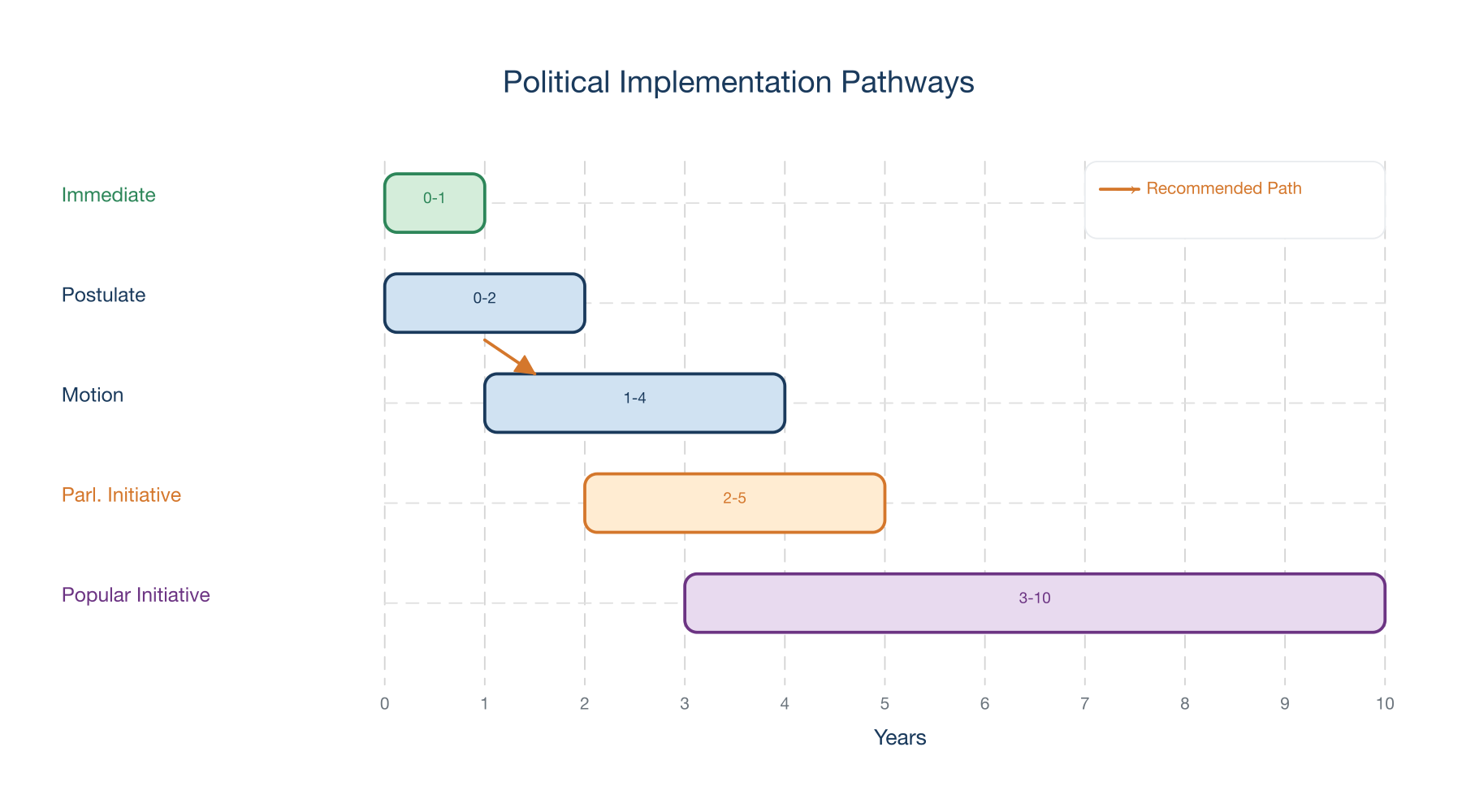
Gantt chart: The five political pathways compared by timeline. The recommended critical path (orange, dashed) runs via postulate → motion → parliamentary deliberation.
¶ Sources
[2] PVK Report on Defence Procurement in the DDPS (2007, PDF)
[3] For a detailed analysis, see armasuisse Weaknesses
[4] Federal Council's Armaments Policy Strategy (June 2025)
[5] Federal Corporate Governance -- Foundations (FFA)
[6] armasuisse Organisation Chart (August 2025, PDF)
[7] Library of Parliament Canada: Defence Procurement Worldwide (2019)
[8] DAPA Official Website (South Korea)
[10] Government of Sweden -- FMV
[11] DE&S Annual Report 2024-25 (UK)
[12] DE&S Corporate Plan 2024-27 (UK, PDF)
[13] DGA Présentation (France)
[14] DGA Organisation (France)
[15] Australia Defence Reform (December 2025)
[16] Canada DIA Announcement (October 2025)
[17] Norton Rose Fulbright: Canada DIA Analysis
[18] Netherlands COMMIT
[19] OECD Recommendation on Public Procurement (2015)
[20] Transparency International Government Defence Integrity Index
[21] FINMA Organisation
[22] ENSI Organisation
[23] FINMA Personnel Ordinance
[24] EFK Independence and Autonomy
[27] ENSI Board Responsibilities
[28] FFA Federal Enterprises and Institutions